Australian Christian Arts presents
The Australian Christian Proms
10% off every ticket · code PROMS
An evening of sacred music. Saturday 29 August 2026 · The Concourse Theatre, Chatswood · Doors 7.00pm, concert 7.30pm · Formal dress. The code PROMS is already filled in at the checkout.
From $45.40, booking fee included · fewer than 500 seats · pick your own seat on the theatre map
The box office may show a short “please wait” screen before the seats appear. That is normal and usually clears in under a minute, so please do not close the tab. On a phone, tap any coloured seat on the map, then Select Ticket Types.
Sat 29 Aug 2026
Doors 7.00pm · concert 7.30pm
The Concourse Theatre
409 Victoria Ave, Chatswood
90 seconds
from Chatswood station
Formal dress
bar open from doors
Why a Proms
The genius of the Proms was never the formality. It was the welcome.
Every year the world's music lovers turn to London's Royal Albert Hall for the Proms: full orchestras, world-class soloists and, on the Last Night, an audience dressed for the occasion. In 1895 the man who started it put the greatest music on earth in a room where ordinary people could walk about, talk, eat and drink. We are borrowing that same spirit of excellence, except this time every piece of music points back to where it was always meant to go: the glory of God.
And it feels like the right moment. There is a growing sense in Sydney that Christians need to be present in the arts again, not commenting from the sidelines but creating work of real beauty, depth and excellence.
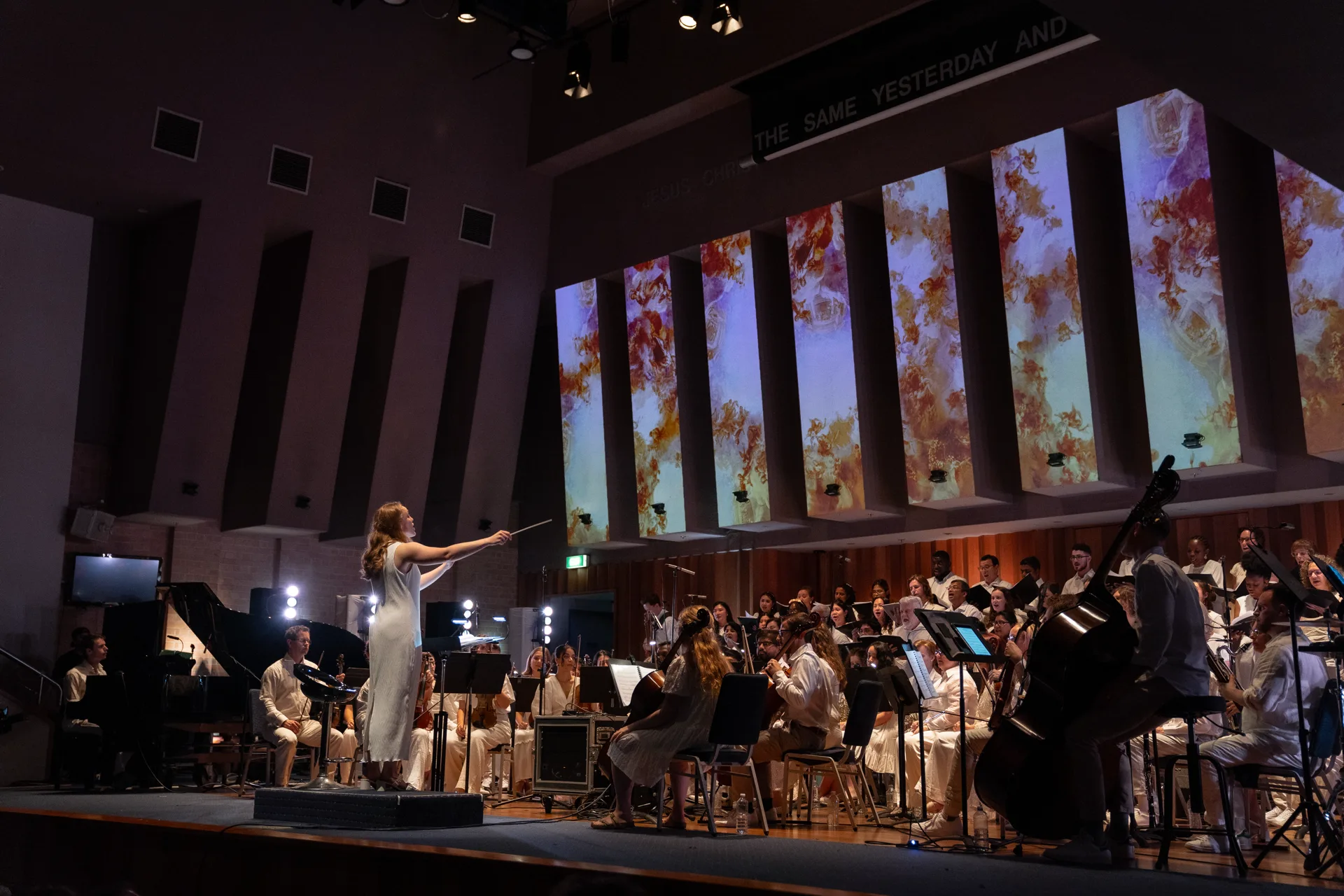
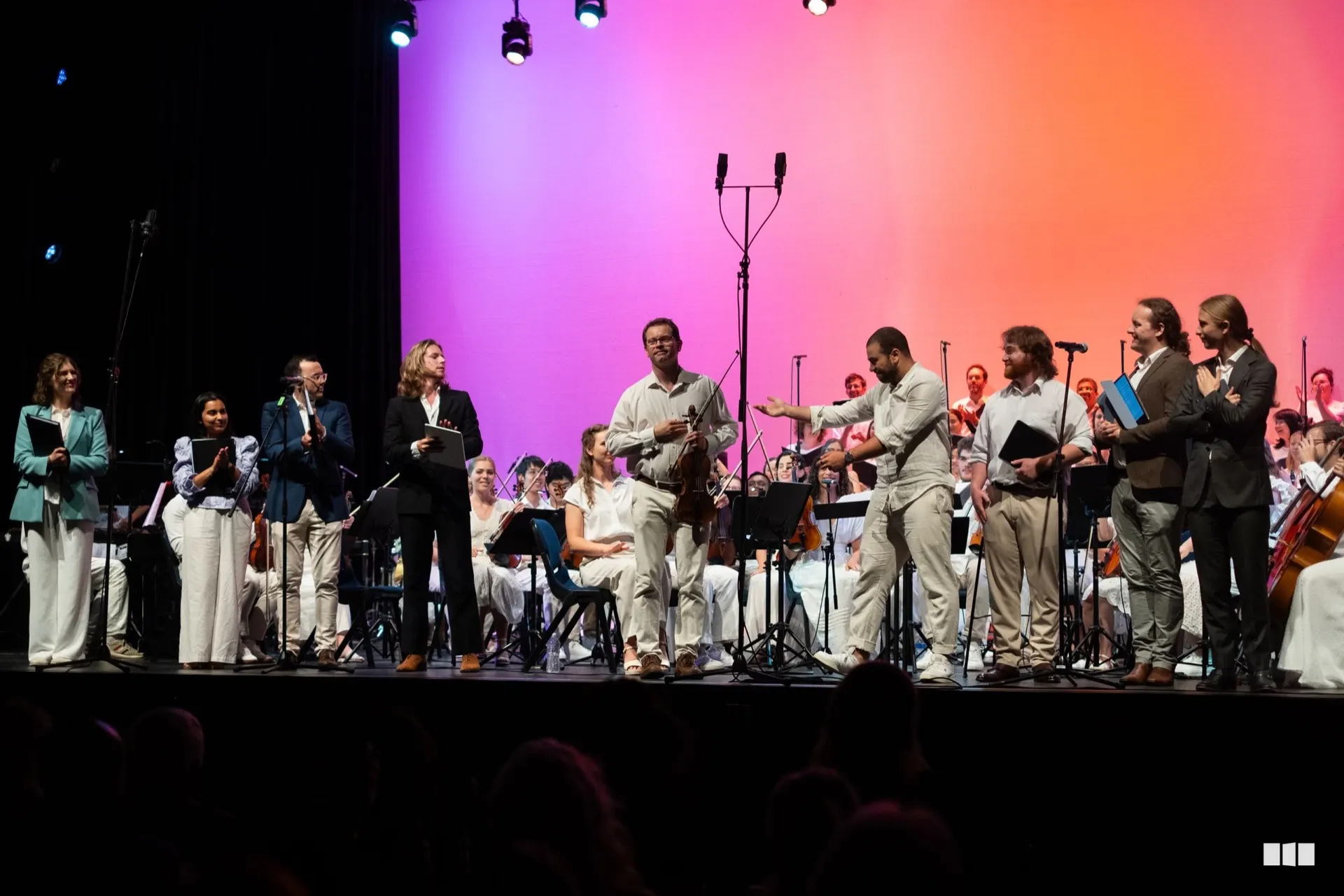
A full symphony orchestra. A choir drawn from more than twenty denominations — Catholics, Anglicans, Pentecostals, Orthodox, Baptists, Methodists, Presbyterians, Salvationists, Adventists and Lutherans on one stage, across generations, sharing a music stand, playing for the same Lord. There is nowhere else in Sydney you can see that.
Much of the music we now hear in concert halls was originally written for the Church, shaped by Christian faith, or created to glorify God. On this night we aim to let the music speak, and let God minister through it.
The evening rests on one line of Scripture, Psalm 150: “Let everything that has breath praise the Lord.” You will hear it three different ways in one night — Dan Forrest's blazing Hallelu Yah, taking hallelujah back to its Hebrew roots; Matt Boswell's setting from a Texas pastor devoted to worship and theology; and John Rutter's Psalm 150 to finish, written for the Queen's Golden Jubilee and first heard beneath the dome of St Paul's Cathedral.
More than 6,600 people have gathered with us since 2022. Eight hundred came to Messiah. Six hundred and fifty came at Christmas. This theatre holds fewer than five hundred.

The Program
Never been to an orchestral concert? Perfect.
You do not need to know anything about classical music to love this night. Here is every piece on the program and why it will get you — Rachmaninoff // Beethoven // Holst // Rutter // Jenkins // Forrest // Clausen // Boswell // Tomlin.
Rachmaninoff — Natalia Raspopova, piano
Étude-Tableau in E-flat minor, Op. 39 No. 5
A dark, towering storm from a composer whose whole life was shaped by his Orthodox faith.
Rachmaninoff was raised in a devout Russian Orthodox household, studied Byzantine chant, and went on to write two of the great masterworks of Orthodox sacred choral music, the Liturgy of St John Chrysostom and the All-Night Vigil. This étude itself is not liturgical, a dark, elegiac showpiece written in 1916 partly in tribute to his friend and colleague Alexander Scriabin after his death, but it comes from the same hands and the same faith that gave the world that sacred music.
Beethoven — Natalia Raspopova, piano
Moonlight Sonata, first movement
You already know this one. You have just never heard it played properly, in a room built for it.
Beethoven never called it the Moonlight. He wrote it in 1801 and marked the opening movement to be played as though from a great distance, delicately and without pedalling off the sound, and a critic later said it reminded him of moonlight on a lake. The name stuck for two hundred years. It is quiet, it is slow, and it does not try to impress you for a second, which is exactly why it has outlasted almost everything written around it.
Dan Forrest
Hallelu Yah: Psalm 150
Think choirs are quiet and polite? Give us three minutes.
A choir with percussion behind it and joy in front of it, singing the oldest party word in the world: hallelujah. Written by a composer who is alive right now, and it moves like something you would actually dance to.
Gustav Holst
O God Beyond All Praising
The greatest tune Holst ever wrote, with the words it was always heading towards.
Holst wrote The Planets before film scores existed, and the melody at the heart of Jupiter is so good that it walked out of the orchestra and became a hymn, sung at weddings and funerals for a century. This is that hymn: orchestra, full choir, and a tune you will recognise inside four notes. If you have ever had goosebumps in a cinema, this is the melody that taught everyone else how.
Chris Tomlin
How Great Is Our God
The song you sing in church, the size it always deserved to be.
Maybe you have sung this chorus a hundred Sundays with a band and a projector. Now picture it with a full choir and symphony orchestra behind it, strings and brass lifting the roof. Familiar words, enormous sound.
René Clausen
All That Hath Life and Breath
No instruments. No microphones. No tricks. Just human voices.
If you have ever fallen down a rabbit hole of a cappella videos, this is that, live, metres away from you. Voices whispering, snapping into rhythm, then opening into a wall of sound with nothing behind it but breath.
Michael Dooley
Suite from The Pilgrim's Progress
A story about a man walking through despair, danger and doubt to get home. Sound familiar?
The Pilgrim's Progress is the original quest story: one ordinary person, an impossible journey, everything trying to stop him. Composer Michael Dooley, alive and writing right now, has turned that journey into music for full orchestra. If you have ever loved a film score, you already speak this language.
Matt Boswell
Psalm 150
A worship song and a symphony orchestra walk into the same room.
Matt Boswell writes the kind of songs churches sing every week, and this one has been handed to a full orchestra with soloists out front. Catchy enough to hum on the drive home, big enough to fill the whole hall.
Karl Jenkins
Benedictus, from The Armed Man
The piece that makes grown adults cry in public. We are not exaggerating.
A single cello starts to sing, so quiet you lean forward. Written in 1999 for the victims of war in Kosovo, it is about what peace sounds like after everything has fallen apart. It builds until the whole choir and orchestra hit at once, and the entire room feels it in their chest. Bring tissues. We mean it.
Australian Christian Youth Orchestra & Choir
The Youth Debut — Holst and Rutter
The moment we have been waiting two years for.
The Australian Christian Youth Orchestra and Youth Choir perform in public for the very first time. They came together in May as the first phase of our youth programs and have rehearsed every week since. On 29 August they walk onto a professional stage, play Holst and Rutter's A Clare Benediction, then stand shoulder to shoulder with the adults for the rest of the night.
John Rutter — sung by the Youth Choir
A Clare Benediction
A blessing spoken over the whole room, sung by our newest voices.
A benediction is the church's oldest goodbye: a blessing spoken over people before they walk back into the world. Rutter's setting, may the Lord show his mercy upon you, is carried entirely by our Youth Choir. Three minutes of pure warmth, and one of those simple, beautiful moments where the whole room breathes a blessing together.
Matt Gibb
Were You There When They Crucified My Lord
The person who wrote this piece will be standing on the stage when you hear it.
Classical music has a reputation: written centuries ago, by people in wigs, somewhere far away. Not this. This eight-part setting comes from Matt Gibb, our own Choir Director, and he will be right there with the singers on the night. Music does not get more alive than that.
Stephen Adams & Frederic E. Weatherly — sung by Alexey of our Youth Choir
The Holy City
Before radio, before streaming, this was one of the biggest hit songs in the world.
Written in 1892 by the same lyricist who gave us Danny Boy, The Holy City is a dream in three acts: children singing in the streets of ancient Jerusalem, a shadow falling over a distant hill, then a blazing vision of a city where the gates stand wide open and night never comes. When the brass and choir hit the refrain, Jerusalem! Jerusalem! Lift up your gates and sing!, you will understand why it is still filling halls 130 years on.
John Rutter — the finale
Psalm 150
The ending is choir, orchestra and brass all at once. The floor moves. So do you.
The last psalm in the Bible has one instruction: let everything that has breath praise the Lord. So for the final piece of the night, everything does. Brass and voices you feel through your shoes. Nobody leaves quietly.
Fewer than 500 seats · from $45.40, booking fee included
On the Podium
Natalia Raspopova.
Leading the Proms is our Music Director and Chief Conductor, Natalia Raspopova, who takes to the piano herself for Rachmaninoff's Étude-Tableau in E-flat minor. Raised in the Russian Orthodox tradition, like Rachmaninoff himself, Natalia has recorded piano with the Sydney Symphony Orchestra, served as Assistant Conductor of the Queensland Symphony Orchestra alongside Simone Young and Marin Alsop, conducted the BBC Concert Orchestra at London's Southbank, and reached the quarter-finals of La Maestra in Paris.
She shares the podium with our Orchestra Director and Senior Conductor, Jonah Eskander, a Sydney Conservatorium trained composer and music director who has led productions across Sydney and conducts several works on the night.
A first for us
The Youth debut.
For the first time in our history, the Australian Christian Youth Orchestra and Youth Choir make their debut alongside our adult orchestra and choir. They have rehearsed every week since May, and on 29 August they walk onto a professional stage and finish the night standing with the adults.
They will also sing Rutter's A Clare Benediction, a blessing over the room before we all walk back out into the world.
Tickets & Pricing
Choose your own seat on the theatre map. Fewer than 500 seats exist, and good seats go first.
Booking is through Century's secure box office for The Concourse, so you pick your exact seat on the theatre map. The code PROMS takes 10% off every ticket, and our buy-tickets link carries it for you automatically.
Best in house
Proms Patron
$115
+ booking fee
Best in the house, includes a program and drink voucher. Only 10 seats.
A Reserve
$60
+ booking fee
Premium stalls seating close to the stage.
B Reserve
$50
+ booking fee
Excellent seats through the centre of the theatre.
C Reserve
$40
+ booking fee
The most affordable way in, with the same full sound.
Concession and child pricing is $5 off B and C Reserve. A Reserve is full price for all patrons. One discount per ticket.
The box office may show a short “please wait” screen before the seats appear. That is normal and usually clears in under a minute, so please do not close the tab. On a phone, tap any coloured seat on the map, then Select Ticket Types.
Good to Know
Everything first-timers ask us.
Reclaiming the arts for Christ.
Saturday 29 August 2026, The Concourse Theatre, Chatswood. Fewer than five hundred seats. Come dressed for it, come early — the bar is open from seven.
Buy tickets now